


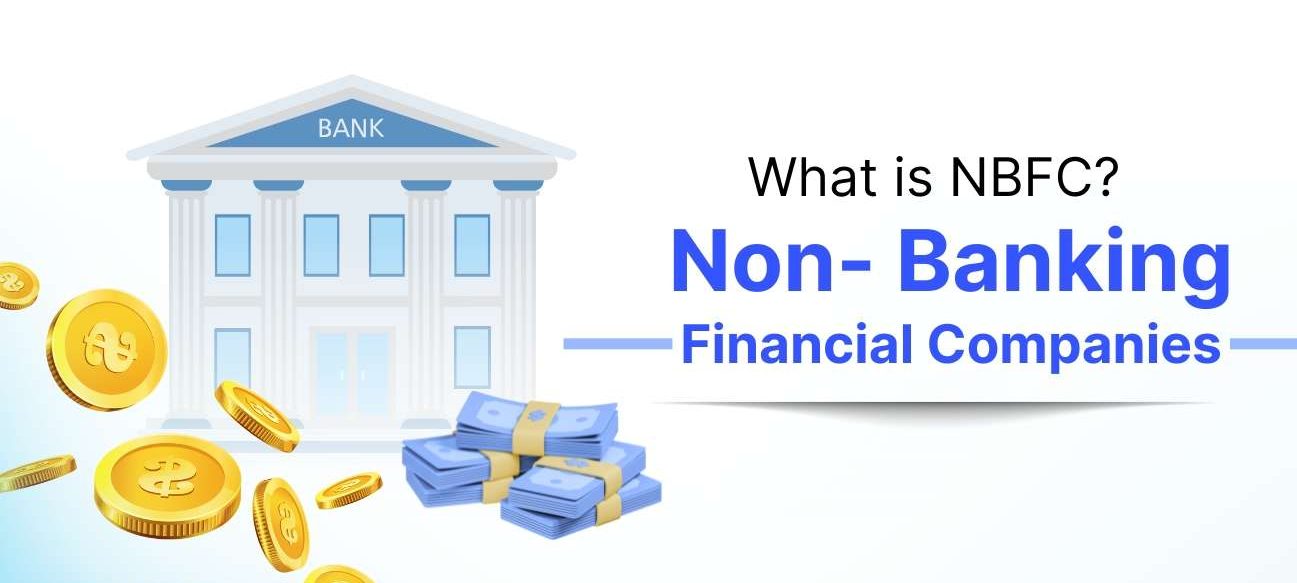
Meaning of NBFC- Non Banking Financial Companies
The acronym NBFC stands for Non-Banking Financial Company. It is a financial institution that offers banking-related services but does not have a banking license. non banking financial companies, unlike traditional banks, do not accept demand deposits (such as savings or current accounts), but they play an important role in providing credit and financial services to businesses and individuals.
They are registered under the Companies Act of 2013 and primarily controlled by the Reserve Bank of India (RBI).
Examples include Bajaj Finance, HDFC Ltd (before merging with HDFC Bank), Tata Capital, and Shriram Finance.
Features of NBFC
- Registration under the Companies Act: Every non banking financial companies must be registered under the Companies Act of 2013.
- Regulated by RBI: The Reserve Bank of India sets guidelines for capital adequacy, lending procedures, and deposit acceptance.
- No demand deposits: Unlike banks, non banking financial companies do not accept savings or current account deposits.
- Credit & Loan Services: They offer loans and credit to people, MSMEs, corporations, and even infrastructure projects.
- Financial Inclusion: They provide financial services to rural and semi-urban areas where banks have a limited presence.
- Investment in market instruments: Many non banking financial companies engage in investment operations such as stock, bond, debenture, and mutual funds.
- High flexibility: Compared to banks, non banking financial companies frequently offer loans with simplified eligibility requirements, faster processing, and less formalities.
- Types of Customers: They serve individuals, startups, MSMEs, corporations, and government projects.
Types of NBFC in India.
Non-banking financial companies in India are classified according to their activities and services:
- Asset Finance Company(AFC)
Provides funding for physical assets that facilitate economic activity.
Examples: Loans for vehicles, machinery, and equipment.
Example companies: Sundaram Finance and Tata Capital.
- Loan Company.
Offers loans and advances for a variety of purposes (excluding asset finance).
Examples: Personal loans, company loans, and consumer durable loans.
Example companies: Bajaj Finance and Shriram City Union Finance.
- Investment Company.
The main business is the acquisition of securities such as stock, bonds, and debentures.
The emphasis is on investment rather than financing.
Example companies include Reliance Capital and L&T Finance Holdings.
- Infrastructure Finance Company(IFC)
Specializes in funding infrastructure projects (roads, ports, airports, and power).
Infrastructure loans must account for at least 75% of total assets deployed.
Example companies: Power Finance Corporation and REC Limited.
- Systemically Important Core Investment Company (CIC-ND-SI).
Holding shares or securities of group firms.
Plays an important part in business arrangements.
The asset size must be at least ₹100 crore.
- Housing Finance NBFCs
Offer home loans to individuals and builders.
Regulated jointly by the RBI and the National Housing Bank.
Example companies include LIC Housing Finance and PNB Housing Finance.
- Microfinance NBFCs (NBFC-MFI )
Offer small loans (up to ₹1.25 lakh) to low-income individuals and groups, generally without collateral.
Help rural and semi-urban borrowers.
Example companies include SKS Microfinance and Spandana Sphoorty.
- NBFC Factors
Specialize in business factoring (the purchase of invoices/bills receivable from businesses to provide them with instant cash).
Example companies are SBI Global Factors Ltd.
- Peer-to-Peer Lending Platforms (NBFC-P2P).
Act as internet portals that connect lenders and borrowers directly.
Examples are Faircent and Lendbox.
- NBFC Account Aggregators (AA)
Collect and share consumer financial data securely (with consent) in order to provide better financial services.
Example: CAMS FinServ and FinVu.
Role of NBFC in the Indian Economy
Non-banking financial companies are a key pillar of India's financial sector. While banks continue to be the dominant source of credit, NBFCs fill key gaps by targeting segments that banks sometimes miss. Their role can be understood in the following ways:
Driving Financial Inclusion
- Non-banking financial companies have a significant presence in rural and semi-urban areas, where banks have few branches.
- They offer microloans, consumer financing, and auto loans to first-time consumers.
Support for MSMEs and startups
- Micro, small, and medium-sized firms (MSMEs), which account for more than 30% of India's GDP, rely heavily on Non-banking financial companies for financing.
- For startups and small enterprises that struggle with collateral requirements, Non-banking financial companies frequently provide speedier approvals and easier qualifying.
Boosting Infrastructure Growth
- Infrastructure Finance Companies (IFCs) are specialized Non-banking financial companies that invest in highways, ports, airports, and power projects.
- This immediately supports India's goal to become a $5 trillion economy.
Diversification of Credit Systems
- Non-banking financial companies provide a variety of finance options, including loans, leasing, hire-purchase, and investment products.
- This minimizes reliance on banks and improves financial resilience.
Creating Jobs
- Non-banking financial companies indirectly contribute to job creation in a variety of industries by lending to small firms, transportation operators, and traders.
Importance of NBFCs for Businesses & Individuals
Non-banking financial companies have a direct impact on people's lives and enterprises, rather than simply being system actors.
For individuals:
Quick Loans: Non-banking financial companies offer personal loans, education loans, gold loans, and consumer durable loans with speedier disbursements.
Financial Accessibility: For those with a limited credit history, Non-banking financial companies serve as the initial step towards financial inclusion.
Housing Support: Housing financing Non-banking financial companies make it easier for middle-class households to purchase homes by offering customized financing choices.

For businesses:
Easy Working Capital: Non-banking financial companies offer both short- and long-term loans for daily operations, inventories, and machinery purchases.
Customized Credit: Unlike banks, many Non-banking financial companies provide flexible repayment plans and sector-specific financing.
MSME Empowerment: NBFC-MFIs and small loan businesses are critical for small business owners, merchants, and rural entrepreneurs.
Startup Boost: Many Non-banking financial companies cooperate with fintechs and peer-to-peer lending platforms to provide alternative funding options for entrepreneurs.

Recent NBFC Trends (2025)
In 2025, the Non-banking financial companies sector will undergo substantial developments and shifts:
- Corporate Funding Shift
- Nearly 50% of India Inc's FY25 finance came from non-bank sources, emphasizing Non-banking financial companies and capital markets as viable alternatives to bank loans.
2. Partnerships between digital lending and fintech.
- Non-banking financial companies are rapidly implementing digital models such as immediate loan applications, AI-powered credit scoring, and paperless onboarding.
- Collaborations with fintech firms allow Non-banking financial companies reach out to millennials, gig workers, and micro-entrepreneurs.
3. Regulatory Tightening by RBI
- The Banking Laws Amendment Act 2025 and the RBI guidelines have improved governance.
- Non-banking financial companies with assets above specified thresholds are now treated equally with banks in terms of compliance.
4. Increased role in MSME financing.
- With banks growing increasingly cautious about hazardous lending, Non-banking financial companies have emerged as the key credit sources for MSMEs.
5. Green and Sustainable Financing
- Many non-bank financial institutions (NBFCs) are focusing on ESG-linked loans (Environment, Social, Governance) and backing renewable energy projects.
6. Investor Attraction
- With SEBI relaxing IPO regulations and allowing international investors to participate, Non-banking financial companies are expected to raise funds more readily, hence boosting their capital base.
Challenges Faced by NBFCs
While NBFCs have developed as an important component of India's financial environment, they also face a number of obstacles that limit their expansion and stability:
- Regulatory Oversight
- The RBI has increased monitoring, yet unexpected regulatory changes might disrupt Non-banking financial companiesoperations.
- Unlike banks, Non-banking financial companies are subject to less stringent rules, which might result in compliance gaps.
2. Funding constraints
- During financial downturns or liquidity crises (such as the IL&FS crisis in 2018), Non-banking financial companies experience severe funding constraints.
- Non-banking financial companies frequently rely on banks, mutual funds, and capital markets to raise funding.


3. High risk of defaults.
- Loan defaults are more likely when NBFCs lend to underserved and high-risk categories such as small firms and individuals with low credit scores.
- Non-performing assets (NPAs) are an ongoing issue.
- 4. Competition between Banks and Fintechs
- Banks are broadening their reach and delivering competitive interest rates, while fintech firms are disrupting with digital-first lending strategies.
- To remain competitive, NBFCs must accelerate their technological adoption.


5. Asset-liability mismatch
- Many NBFCs borrow short-term cash but lend long-term (for example, house loans and infrastructure finance).
- This mismatch causes liquidity concerns, particularly during market stress.
6. Macroeconomic vulnerabilities.
- Inflation, interest rate fluctuations, and global financial uncertainty have a direct impact on the borrowing costs and repayment capacity of NBFC consumers.

Future of NBFCs in India
Despite the obstacles, NBFCs are projected to play an even greater role in the future of India's financial sector. Here's why.
Deeper Financial Inclusion
- With India's rural and semi-urban populations remain neglected by banks, NBFCs will continue to fill the void by providing microloans, consumer finance, and agricultural credit.
Digital transformation
- NBFCs are rapidly using AI, data analytics, and mobile platforms for credit assessment, loan distribution, and customer support.
- Digital lending is expected to be one of the fastest-growing categories in the NBFC industry.
Partnerships with Fintech and Banks
- Collaboration among NBFCs, fintech firms, and traditional banks will result in hybrid lending models, increasing efficiency and outreach.
Regulatory strengthening
- To build a stronger and more stable financial sector, the RBI has been harmonizing NBFC regulations with those of banks.
- This will boost investor trust and strengthen governance in the sector.
Focus on Specialized Lending
- NBFCs will concentrate on specialist markets such as renewable energy financing, SME loans, education loans, and car financing.
Increase in Asset Base
- With India's economy poised to reach $5 trillion, demand for loans is projected to rise. The assets under management (AUM) of NBFCs are expected to increase significantly.
Conclusion
Non-Banking Financial Companies (NBFCs) have emerged as a key component of India's financial system, working alongside banks to provide credit to individuals, small enterprises, and rural areas. They promote financial inclusion, economic development, and credit innovation.
However, issues including as liquidity risks, defaults, and regulatory compliance must be addressed effectively. With increased digital penetration, government support, and regulatory reforms, the future of NBFCs appears bright, making them an important component of India's growth story.
Read more of our latest blogs here: Click here