


What is an ESOP?
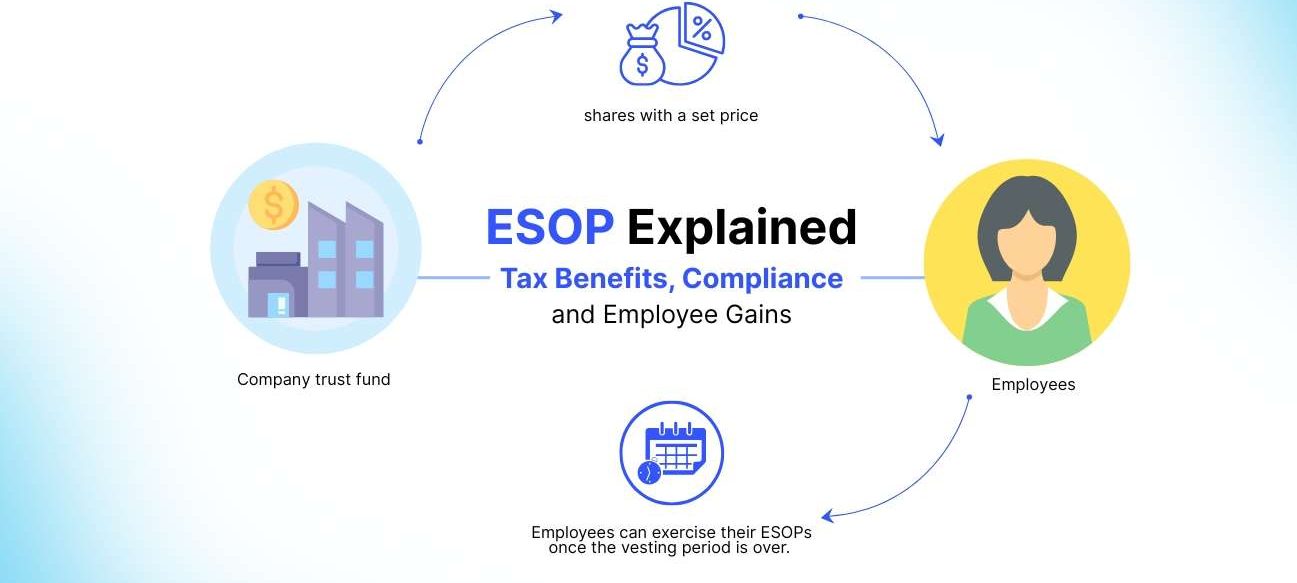
A program that enables employees of a company to purchase ownership in the form of company shares is known as an Employee Stock Option Plan. In essence, it provides workers with the choice to purchase a set quantity of company stock at a fixed price (sometimes referred to as the strike price or exercise price) at a predefined point in time. By fostering a sense of ownership and providing incentives for sustained performance, ESOPs aim to bring the company's interests and those of its employees into alignment.
Difference between an ESOP and other equity plans:
Employee Stock Ownership Plan are a sort of equity compensation, although they differ from other stock-based programs such as restricted stock units (RSUs) or sweat equity shares.
- Employee stock ownership plans (ESOPs) allow employees to buy shares at a defined price after a vesting period. Ownership is optional until exercised.
- RSUs: Employees are given shares outright after a vesting period, with no purchase necessary.
- Sweat Equity Shares: These are shares offered to employees or directors at a discount or for anything other than cash, typically in recognition of their efforts or skills.
Employee Stock Ownership Plan are especially popular in startups and fast-growing businesses because they allow employees to profit financially if the firm's value rises without the corporation having to spend money up front.
How ESOPs Work
Granting, vesting, and exercising options
An ESOP's life cycle is often divided into three stages:
- Grant: The corporation grants stock options to employees at a predetermined strike price. The award includes the total number of options, the strike price, and the vesting schedule.
- Vesting: Vesting refers to the waiting period before an employee can exercise their options. Common vesting schedules are 3-5 years, with a one-year cliff period, which means no options can be exercised before the one-year mark. Vesting motivates employees to stay with the company longer.
- Exercising Options: After vesting, employees can purchase company shares at the strike price, regardless of market value. This is referred to as exercising an option. If the company's market value has increased, employees can sell their shares for a profit.
Example of ESOP Allocation:
Let’s say a startup grants an employee 1,000 options at a strike price of ₹100 per share. The vesting period is 4 years with a 1-year cliff. After 4 years, the employee can exercise all 1,000 options. If the market value of the shares has risen to ₹300 per share:
- Cost to exercise: ₹100 × 1,000 = ₹1,00,000
- Market value: ₹300 × 1,000 = ₹3,00,000
- Profit: ₹3,00,000 – ₹1,00,000 = ₹2,00,000
This example demonstrates how Employee Stock Ownership Plans can be a powerful tool for employee wealth creation and motivation.
Tax Benefits for Employees and Companies
Tax Implications for Grant, Vesting, and Exercise:
Understanding the taxation of Employee Stock Ownership Plan is critical for both employees and employers. In India, ESOP taxation takes place at various stages:
- Grant Stage: During the grant stage, employees are not subject to any tax liability. The corporation simply issues stock options to the employee at a predetermined strike price.
- Vesting Stage: During the vesting stage, employees are not required to pay any taxes. Vesting simply indicates that the employee has earned the right to exercise the options, but no transaction has occurred yet.
- Exercise Stage: When an employee chooses to exercise their options, they incur tax liabilities. The difference between the fair market value (FMV) of the shares at exercise and the strike price is considered a perquisite and is taxable as salary income.
Example:
Assuming an employee exercises 1,000 options at a strike price of ₹100 and the FMV is ₹300:
- Perquisite value: (₹300 - ₹100) multiplied by 1,000 equals ₹2,00,000
- The ₹2,00,000 is added to the employee's wages and taxed based on their income tax slab.
Capital gains and exemptions apply when an employee sells shares after exercising options.
- Short-Term Capital Gains (STCG): Gains on shares sold within 24 months are taxed at 15% (for listed shares).
- Long-Term Capital Gains (LTCG): Gains over ₹1 lakh on shares sold after 24 months are taxed at 10% without indexation.
- This gives employees the possibility to build enormous wealth if the company's worth increases over time.
Tax Benefits for Companies Offering ESOPs:
- Companies can deduct the perquisite value of Employee Stock Ownership Plan granted to employees, which reduces taxable revenue.
- Employee Stock Ownership Plan allow businesses to compensate employees without incurring immediate financial outflows, which improves cash flow management.
- Offering Employee Stock Ownership Plan can also help to retain talent and match employee interests with corporate growth, hence improving financial success.
Compliance requirements for ESOPs
ESOPs in India are generally governed by the following regulatory framework:
- The Companies Act of 2013 - Sections 62(1)(b) and 67 govern the issue and management of Employee Stock Ownership Plan.
- SEBI (Employee Stock Option Scheme and Employee Stock Purchase Scheme) Guidelines, 2021 - Applicable to listed businesses that issue Employee Stock Ownership Plan.
- The Income Tax Act of 1961 determines the tax status of employees and businesses.
Filing and Reporting Obligations:
- Board Approval: Employee Stock Ownership Plan plans must be approved by the board of directors.
- Shareholder Approval: Shareholder approval is required at a general meeting, particularly for the issue of new shares through ESOPs.
- Filing with the Registrar of Companies (ROC): Companies must file applicable forms (such as Form PAS-3 for share allotment) and keep suitable records.
- Disclosure Requirements: Listed businesses must include Employee Stock Ownership Plan grants in their financial statements and adhere to SEBI reporting rules.
ESOP agreements and approvals:
- Every employee who receives ESOPs must sign an ESOP agreement that specifies the award date, strike price, vesting schedule, exercise period, and conditions for exit or termination.
- Audit and Compliance: Companies must undertake frequent audits to ensure that regulations are followed, options are properly accounted for, and perquisites are reported for tax purposes.
Advantages of ESOPs for Employees

1.Ownership Mindset and Motivation: ESOPs encourage employees to become co-owners of the company, leading to a shift in their mindset and motivation. When employees have a stake in the company, they are naturally more invested in its success. This sense of ownership promotes greater drive, accountability, and productivity. Employees feel personally connected to the company's success, understanding that their efforts help to improve the company's value—and, ultimately, their own financial gain.
2. Wealth Creation Opportunities: Employee stock ownership plans (ESOPs) allow employees to benefit from the company's future success. Employee shares become more valuable when the company's valuation rises. When a startup or high-growth company goes public or is purchased, this can result in significant wealth creation, even for middle-level employees. In essence, ESOPs convert dedicated employees into long-term investors in the company's future.


3. Retention and Loyalty Benefits: Because ESOPs often have a vesting time, employees are urged to stay with the company for several years before receiving their rewards. This not only minimizes attrition, but it also results in a more experienced staff. Employees who feel valued and rewarded for their contributions are less likely to change positions, resulting in long-term stability for the firm.
Advantages of ESOPs for Companies
1.Attracting and Retaining Top Talent: Startups and developing businesses frequently struggle to compete with established companies' hefty wage packages. ESOPs are a viable alternative, allowing businesses to attract qualified people by offering possible long-term financial advantages. They serve as an effective retention tool since employees are more inclined to stay and grow with a company that offers ownership opportunities.


2. Aligning Employee Goals with Business Growth: ESOPs ensure that employees and management are working toward the same goal: boosting the company's worth. When employees become shareholders, they are more likely to take responsibility for their responsibilities, think strategically, and contribute to decisions that drive profitability and sustainability. This alignment promotes teamwork, innovation, and overall performance.
3. Cashless Compensation Option: For companies with little cash flow, ESOPs offer an affordable pay method. Instead of paying huge salaries up front, businesses might provide stock options that reward employees as the company grows. This helps to conserve cash in the early stages while also keeping the workforce motivated and invested in long-term success.

Common Challenges and How to Avoid Them
Valuation Complexities
- Determining the fair market value (FMV) of shares is a major difficulty when issuing ESOPs. Incorrect valuation might cause compliance concerns and tax complications.
How to Avoid It:
- Engage a certified valuer or a professional valuation firm to ensure the process is accurate and transparent.
Dilution Concerns
- Issuing ESOPs may diminish the equity of existing owners due to the creation of new shares. Overallocation of ESOPs may have an influence on ownership control.
How to Avoid It:
- Set clear ESOP pool limits (often 5-10% of total share capital) and evaluate allocations on a yearly basis to ensure a balanced equity structure.
Legal and Tax Pitfalls
- Improper documentation, noncompliance with SEBI or Companies Act regulations, or failure to accurately disclose ESOP transactions can result in penalties and legal issues.
How to Avoid It
- Collaborate with legal and compliance specialists to verify that all files, agreements, and disclosures are compliant with Indian regulations.
Conclusion / Key Takeaways
ESOPs benefit both employees and corporations. They provide employees with ownership, incentive, and financial progress, while also allowing businesses to attract, retain, and align elite personnel with long-term objectives.
However, ESOPs have extensive legal, tax, and compliance requirements. As a result, seeking professional help is critical for efficiently designing, implementing, and managing ESOPs.
FilingPro assists organizations with all stages of ESOP implementation, from structuring and compliance to reporting, assuring a smooth and compliant process.
Read Our Latest Blogs : Click Here