



Introduction to IPO.
In today's volatile financial environment, businesses frequently seek substantial sums of capital to grow, expand operations, decrease debt, or enter new markets. One of the most successful methods to accomplish this is through an initial public offering (IPO). An Initial Public Offering is a key milestone in a company's history because it is the first time the company sells shares to the general public and becomes a publicly traded entity on the stock exchange.
Going public allows firms to not only raise capital, but also earn visibility, credibility, and trust from investors, stakeholders, and customers. IPOs provide investors with the opportunity to purchase shares early in a company's growth narrative.
What is an Initial Public Offering (IPO)?
An IPO (Initial Public Offering) is the procedure by which a privately held firm first makes its shares available to the general public. Following an Initial Public Offering, the company's shares are listed on a stock exchange (such as NSE or BSE in India), allowing investors to freely buy and sell them.
Key Points About Initial Public Offering:
- It enables a corporation to raise funds directly from public investors.
- It changes a private firm into a public one.
- It provides liquidity for early investors, entrepreneurs, and promoters.
- It allows the general public to contribute to the company's future growth.
- In layman's terms, an Initial Public Offering is the link between a private company and public ownership.
Why Companies Go Public.
Companies choose to go public for a variety of strategic reasons:
- Raising Capital for Growth: Going public enables companies to raise significant capital for expansion, R&D, marketing, and acquisitions.
- Debt Repayment: Using IPO proceeds to repay debt can improve a company's financial health.
- Increased Credibility and Brand Value: Listed companies benefit from increased visibility, client trust, and improved commercial prospects.
- Liquidity for Existing Investors: Existing investors, including founders and venture capitalists, may be able to sell their interest during or after an IPO, providing liquidity.
- Employee Motivation: Public corporations might offer stock options (ESOPs) to motivate and retain outstanding workers.
Types of IPOs
When a firm decides to obtain capital through an IPO, it has two basic options for issuing shares: fixed price IPOs and book building IPOs.
- Fixed-price IPO: In a Fixed Price IPO, the company sets the price at which its shares will be offered to the public. Investors are aware of this pricing before subscribing to the issue. Key features: The share price is predetermined and disclosed in advance. Investors must pay the entire application fee upfront at the time of bidding. Demand for shares is only obvious after the IPO has closed. For instance, if a company sets an IPO price of ₹150 per share, all investors who apply will pay the same amount, regardless of demand.
This strategy is simple and clear, making it accessible to first-time investors.

2. Bookbuilding IPO: In a Book Building IPO, the company provides a price range rather than a single price. Investors put bids within this range, and the ultimate price (known as the cut-off price) is decided by assessing the demand for shares. Key features: A price range is specified (e.g., ₹200-₹220 per share). Investors can choose the price they are willing to pay within the band. The cut-off price is determined by demand and supply. Shares are allocated to those who bid at or above the cut-off price. If the price range is ₹200-₹220 and most bids are around ₹215, the company may set ₹215 as the cut-off price.
Book building is extensively used today since it helps to determine a fair market price and improves transparency.
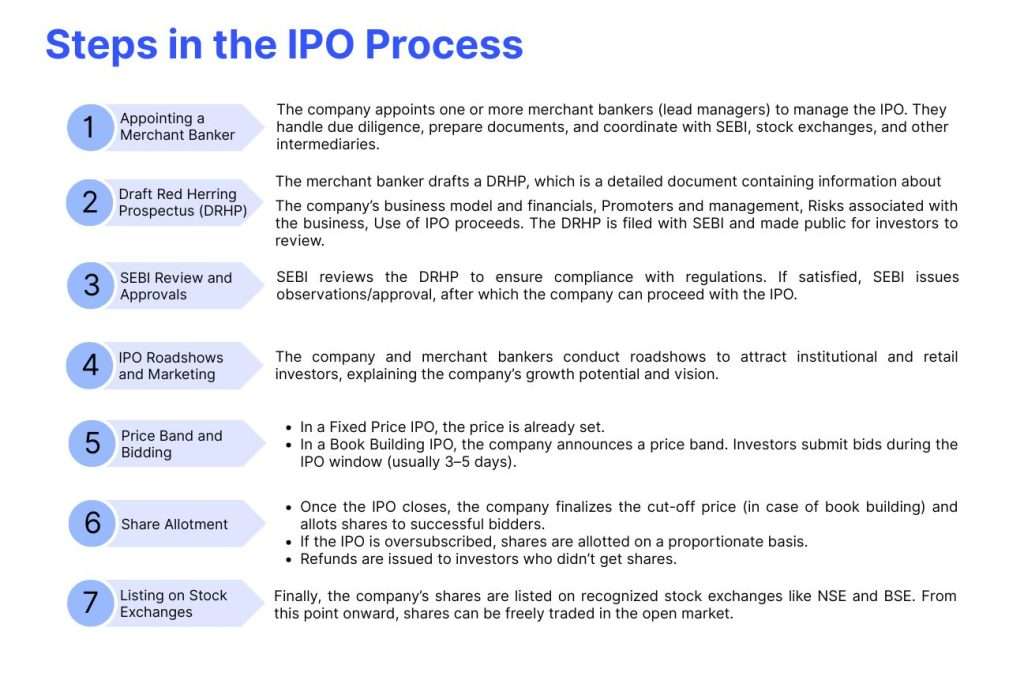
Initial Public Offering Process in India
To safeguard investors and maintain market integrity, the Securities and Exchange Board of India (SEBI) strictly regulates the IPO process in India.
Eligibility criteria (SEBI norms)
SEBI has established the following criteria for a company to be qualified for an IPO in India:
Net Worth and Profitability Criteria:
- The company must have a tangible net worth of at least ₹3 crore within the last three years.
- The company should have generated operating profits of at least ₹15 crore during the last three years.
Capitalization requirements:
- The post-issue paid-up capital should be at least ₹10 crore.
- The issue size should not be more than five times the company's net worth prior to the Initial Public Offering.
Track Record:
- The company's track record must be at least three years.
- New-age startups or loss-making businesses can still go public through the Innovators Growth Platform (IGP) if they meet additional eligibility requirements.
Minimum shareholding by promoters:
- Promoters must own at least 20% of the post-issue capital, which is locked in for three years.
Benefits of IPO for Companies
Going public is a strategic step that can change a company's future, not just a fundraising effort. Here's how.
Raising capital
The most direct and major advantage of an Initial Public Offering is the potential to raise large sums of money from the public. The funding can be used for:
- Expanding into new markets or regions.
- Investing in infrastructure, research, and technology
- Acquiring other businesses
- Reducing or repaying current debts
- This inflow of funds enables businesses to grow without relying entirely on loans or private finance.
Enhanced Credibility
Listing on a stock exchange boosts a company's credibility, transparency, and responsibility. A public firm is expected to publish its financials and follow SEBI requirements, which increases investor trust.
- Customers perceive listed companies as more trustworthy.
- Vendors and partners are more open to collaboration.
- Media visibility improves, boosting the brand image. Overall, public listing increases reputation and attracts more company chances.
Market Expansion
An Initial Public Offering provides a company with not only financial benefits, but also visibility and reach. With more resources and credibility, businesses can:
- Enter new product categories and markets.
- Scale operations faster.
- Compete with huge industry players.
Furthermore, having a publicly traded firm can make it easier to raise cash in the future, whether through Follow-on Public Offers (FPOs) or debt instruments.
Investor Advantages of an Initial Public Offering
IPOs are exciting for investors because they provide an opportunity to participate in a company's growth story from the start.
- Early Investment Opportunities
Individuals who participate in an Initial Public Offering have the opportunity to purchase shares of a company before it becomes public. If the company grows significantly, IPO investors will benefit from the early entry.
- Companies such as Infosys, Wipro, and Reliance generated enormous riches for their early investors.
2. Opportunity for High Returns
IPOs can result in significant short- and long-term gains:
- Listing Gains: If there is strong demand for the Initial Public Offering, the share price will often list higher than the issue price, resulting in an immediate profit.
- Long-term Growth: If the company performs successfully, early investors receive exponential returns as the stock price rises over time.
3. Liquidity
- Once the IPO shares are listed on a stock exchange, they can be freely traded. This allows investors the flexibility to:
- After the listing, sell shares to make a rapid profit. Keep them as a long-term investment in wealth creation.
Liquidity ensures that investors are not locked in and can exit when they want (except for promoters, who have a lock-in period).
Risks associated with IPOs.
While IPOs have numerous advantages, they also have dangers that firms and investors must carefully assess before making a choice.
- Market Volatility.
The stock market is influenced by a variety of factors, including global events, economic conditions, interest rates, and investor sentiment. Even if a firm is fundamentally sound, bad market conditions can have an impact on Initial Public Offering demand and post-listing share prices.
An Initial Public Offering may be oversubscribed yet still list at a discount if the overall market falls.
2. Overvaluation Risks
Companies sometimes overprice their initial public offerings (IPOs) in anticipation of substantial investor demand. If investors believe the valuation is not justified in light of the company's financials, the IPO may underperform after listing.
Overvalued IPOs frequently result in losses for investors that buy at the issue price.
3. Lock-in Period Issues
SEBI requires promoters and certain institutional investors to serve a lock-in period (often 6 months to 3 years) during which they are unable to sell their shares. This restriction maintains stability, but it can also create selling pressure once the lock-in period expires, causing stock prices to fluctuate.
Despite the lack of a lock-in period, individual investors face uncertainty if the stock performs poorly shortly after listing.
How to Apply for an IPO in India?
In recent years, India's IPO application procedure has gotten more straightforward and digital. Investors can apply using two primary methods:
- Using ASBA (Application Supported by Blocked Amount).
ASBA is the most used procedure for IPO applications. This is how it works.
- Investors apply for IPO shares using their bank accounts.
- The bid amount is frozen in the account but not debited until the shares are allocated.
- If shares are not allotted, the frozen monies are freed automatically.
- This assures that the investment procedure is safe and hassle-free.
- Most banks in India (both private and public) offer ASBA services via internet banking and mobile applications.
2. UPI-Based Process
In recent years, SEBI has launched UPI-based IPO applications to make the process even easier for retail investors.
- Investors can apply directly for IPOs using brokerage apps or depository participants (such as Zerodha, Groww, and Upstox).
- During the application process, investors enter their UPI ID and authorize a mandate through their UPI app (e.g., Google Pay, PhonePe, Paytm, BHIM).
- Similar to ASBA, the IPO amount is held until allotment.
This strategy has gained popularity due to its convenience, particularly among young investors.
Sectors Gaining Traction
Key sectors garnering investor interest in 2025 include:
- Cybersecurity: Companies such as Netskope and SailPoint are capitalizing on the increased need for AI-powered data security solutions.
- Mobility and Industrials: Driven by reshoring and supply chain localization, the mobility sub-sector has seen a surge in IPO activity.
- Energy Infrastructure: With a focus on vital infrastructure, energy IPOs are gaining traction.
- Defense technology: IPOs are becoming more popular as global defense spending rise
- Life Sciences and Biotech: Biotech innovations are generating investment interest, notably in the life sciences industry.
Tips for Investors
Investing in initial public offerings (IPOs) takes careful thinking. Key strategies include:
- Conduct thorough research: Read the Draft Red Herring Prospectus (DRHP) to learn about the company's financial health, business model, and industry forecast.
StockGro - Financials and Valuation: Evaluate revenue growth, profitability, and valuation measures against industry peers.
Mncl Group - Understand the Business Model: Ensure that the company's business model is scalable and ready for the future.
Mncl Group - Consider Market situations: Be aware of larger market movements and economic situations that could affect the IPO's performance.
How To Analyze IPOs
A complete IPO examination includes:
- Financial Health: Examine audited financial documents from the last 3-5 years, concentrating on revenue trends, profitability, and cash flow.
Kotak Securities - Management and Governance: Evaluate the experience and track record of the management team and board of directors.
- Industry Position: Evaluate the company's competitive position and development possibilities.
- Identify potential risks, such as market competition, legislative changes, and operational issues.
Common Mistakes To Avoid
Investors should be wary about:
- Falling for Hype: Do not base your investment selections simply on media excitement or immediate listing gains.
IPO Pro - Ignoring Lock-Up Periods: Understand how lock-up periods affect stock liquidity and price volatility.
- Overlooking Valuation: Ensure that the IPO is properly priced in comparison to its financial performance and industry peers.
IPO Pro - Inadequate Research: Before investing in an IPO, conduct rigorous due diligence.
Conclusion
IPOs are a strategic strategy for raising funds and providing investors with access to growth possibilities. However, successful participation necessitates extensive due diligence, an awareness of market dynamics, and a rigorous assessment of the offering's fundamentals. Using a disciplined strategy, investors may effectively traverse the IPO landscape and make educated investment selections.
Read our Latest Blogs: Click Here